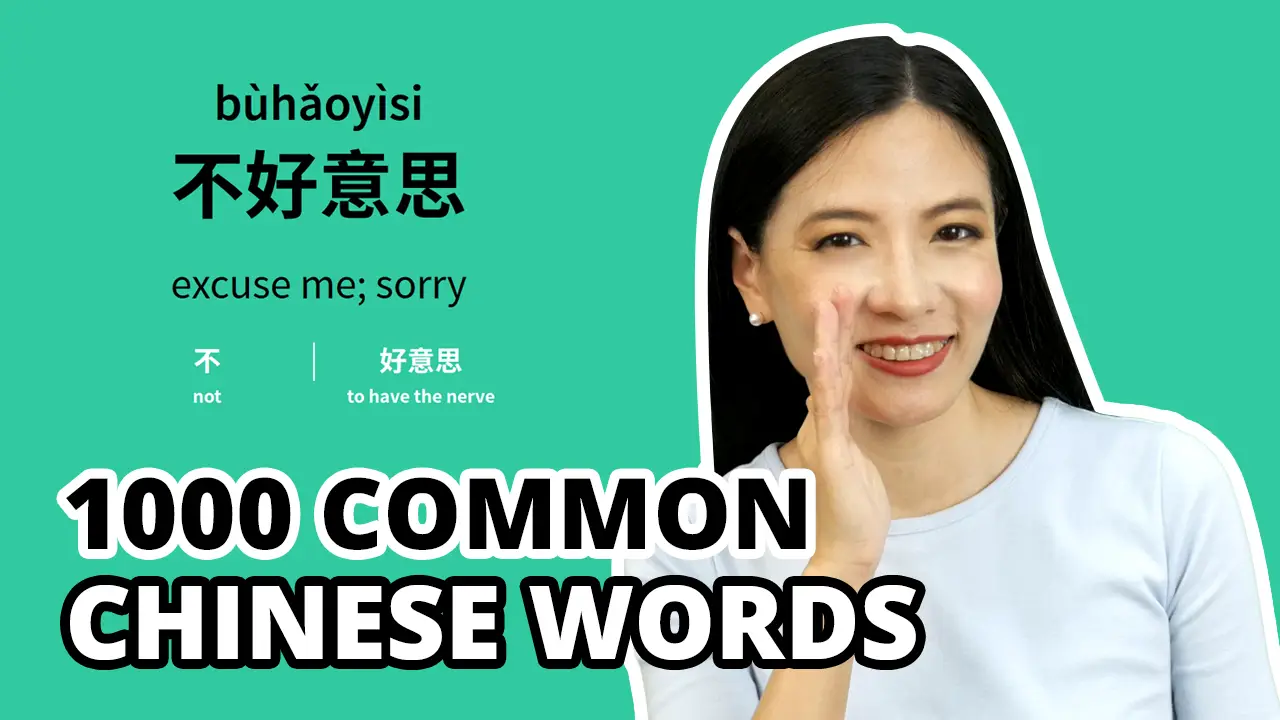
1000 Most Common Chinese Words For Beginners – Lesson 23

Oops...This Lesson is for subscribers
Subscribe Now

1000 Most Common Chinese Words For Beginners: Lesson 23

In this 23rd lesson of our "1000 Most Common Chinese Words For Beginners" Course, we will learn another group of the 1000 Most Common Chinese Words, which contains the following 20 words and phrases that are very useful for daily Chinese conversations:

  • 过 guo ▸ p. aspect particle suggesting that an action or event is something that has happened before
  • 行吗 xíng ma ▸ (will it) work; (will it) be okay
  • 又 yòu ▸ adv. again; more over; once more (for something already happened once)
  • 哪里哪里 nǎlǐ nǎlǐ ▸ "where-where"(a humble and polite way to deflect praise and show modesty)
  • 元 yuán ▸ m.w. measure word for money
  • 块 kuài ▸ m.w. (colloq.) measure word for money
  • 明白 míngbai ▸ v. to know; to understand; to make sense of
  • 上午 shàngwǔ ▸ n. morning; before noon
  • 中午 zhōngwǔ ▸ n. noon
  • 下午 xiàwǔ ▸ n. afternoon
  • 卧室 wòshì ▸ n. bedroom
  • 见面 jiànmiàn ▸ v. / v. phr. to meet face to face
  • 外面 wàimiàn ▸ n. outside; the outer or external part
  • 差 chà ▸ adj. bad; not good
  • 挺 tǐng ▸ adv. pretty; very
  • 来自 láizì ▸ v. to come from; to be from
  • 鸡 jī ▸ n. chicken
  • 客厅 kètīng ▸ n. living room; family room
  • 关机 guān jī ▸ v. phr. to turn off (an electronic device)
  • 开机 kāi jī ▸ v. phr. to turn on (an electronic device)

 

VOCABULARY USAGE


1.
过 guo

p. ▸ aspect particle suggesting that an action or event is something that has happened before

EXAMPLE SENTENCES

  • Nǐ chī guo yuèbing mā?
    你吃过月饼吗?
    You eat -guo mooncake -ma?
    (Have) you eaten(/had) mooncake (before)?
  • Wǒ yǐjīng kàn guo zhè bù diànyǐng le.
    我已经看过这部电影了。
    I already see -guo this “bu” movie -le.
    I already (have) seen this “bu” (of) movie.

2.
行吗 xíng ma

(will it) work; (will it) be okay

EXAMPLE SENTENCES

  • Piányi yì diǎn, xíng ma?
    便宜一点,行吗?
    Cheap one “dian”, work -ma?
    “A little bit” cheaper, okay?
  • Wǒ míngtiān qǐng jià yì tiān, xíng ma?
    我明天请假一天,行吗?
    I tomorrow ask-for-leave one day, work -ma?
    I tomorrow take-a-day-off (for) one day, okay?

3.
又 yòu

adv. ▸ again; more over; once more (for something already happened before)

EXAMPLE SENTENCES

  • Wǒ yòu wàng le wǒ de yóuxiāng mìmǎ.
    我又忘了我的邮箱密码。
    I again forget -le my email password.
    I again forgot my email password.
  • Wǒ yòu rènshi le hěn duō xīn péngyou.
    我又认识了很多新朋友。
    I again meet -le very many new friend.
    I again met very many new friends.

4.
哪里哪里 nǎlǐ nǎlǐ

"where-where"(a humble and polite way to deflect praise and show modesty)

EXAMPLE SENTENCES

    • Nǐ chànggē zhēn hǎotīng!
      A 你唱歌真好听!
      You sing-song really good-sounding!
      You singing-song (is) really good-sounding!
      Nǎlǐ nǎlǐ!
      B 哪里哪里!
      Yes? I too want to watch.
      “Where-Where”!
    • No, no!
      A 你的中文说得真棒!
      Your Chinese speak -de- really great!
      Your Chinese speaks(/is) really great!
      Nǎlǐ nǎlǐ!
      B 哪里哪里!
      “Where-Where”!
      No, no!

5.
元 yuán

m.w. ▸ measure word for money

EXAMPLE SENTENCES

  • Niúròu yì jīn sānshí yuán.
    牛肉一斤三十元。
    Beef one “jin(/500 gram)” 30 yuan.
    Beef (for) one “jin(/500 gram)” (is) 30 yuan.
  • Zhèxiē yígòng liǎngbǎi yuán.
    这些一共两百元。
    These altogether 200 yuan.
    These altogether (is) 200 yuan.

6.
块 kuài

m.w. ▸ (colloq.) measure word for money

EXAMPLE SENTENCES

  • Wǒ mǎi le shí kuài qián de cǎipiào.
    我买了十块钱的彩票。
    I buy -le 10 “kuai” money -de- lottery-ticket.
    I bought (a) lottery-ticket (that costs) 10 “kuai” (of) money.
  • Wǒ xūyào jǐ kuài língqián.
    我需要几块零钱。
    I need several “kuai” money.
    I need (some) change (that is worth) several “kuai” (of) money.

7.
明白 míngbai

v. ▸ to know; to understand; to make sense of

EXAMPLE SENTENCES

  • Nǐ míngbai wǒ de yìsi ma?
    你明白我的意思吗?
    You understand my meaning -ma?
    (Do) you understand my meaning? [Do you know what I mean?]
  • Duìbuqǐ, wǒ méi tīng míngbai, nǐ néng zài shuō yí biàn ma?
    对不起,我没听明白,你能再说一遍吗?
    Sorry, I not hear understand, you can again say one “bian” -ma?
    Sorry, I was-not-able-to-hear-(and-)understand, can you say (it) again (for) one “time”?

8.
上午 shàngwǔ

n. ▸ morning; before noon

EXAMPLE SENTENCES

  • Wǒ míngtiān shàngwǔ méi kòng.
    我明天上午没空。
    I tomorrow morning not-have free-time.
    I tomorrow morning (do) not-have free-time.
  • Wǒmen dìng shàngwǔ de jīpiào ba.
    我们订上午的机票吧。
    We book morning -de- plane-ticket -ba!
    (Let) us book plane-tickets (of the) morning!

9.
中午 zhōngwǔ

n. ▸ noon

EXAMPLE SENTENCES

  • Tā jīntiān shuì dào zhōngwǔ cái qǐchuáng.
    他今天睡到中午才起床。
    He today sleep “arriving” noon “as late as” get-up-(from-)bed.
    Today he slept till “as late as” noon (and then) got-up(-from-)bed.
  • Wǒ zhōngwǔ yǒu liǎng ge xiǎoshí de xiūxi shíjiān.
    我中午有两个小时的休息时间。
    I noon have two “ge” hour -de- rest time.
    I (at) noon have two “ge” (of) hours (that are) rest time.

10.
下午 xiàwǔ

n. ▸ afternoon

EXAMPLE SENTENCES

  • Wǒ měitiān xiàwǔ liù diǎn xiàbān.
    我每天下午六点下班。
    I every day afternoon 6 o’clock get-off-work.
    I every day get-off-work (at) afternoon 6 o’clock.
  • Nǐ xiǎng shàngwǔ qù háishi xiàwǔ qù?
    你想上午去还是下午去?
    You want to morning go or afternoon go?
    (Do) you want to go (in the) morning (or) go (in the) afternoon?

11.
卧室 wòshì

n. ▸ bedroom

EXAMPLE SENTENCES

  • Zhè dòng fángzi yǒu jǐ jiān wòshì?
    这栋房子有几间卧室?
    This “dong” house have what-number “jian” bedroom?
    How-many “jian” (of) bedrooms (does) this “dong” (of) house have?
  • Wòshì de qiáng shì lánsè de.
    卧室的墙是蓝色的。
    Bedroom -de- wall is blue-color -de.
    (The) bedroom walls (are something that are of the) blue-color.

12.
见面 jiànmiàn

v. / v. phr. ▸ to meet face to face

EXAMPLE SENTENCES

  • Wǒmen shàng cì jiànmiàn shì shénme shíhou?
    我们上次见面是什么时候?
    We last-time meet-face is what time?
    When was (the) last-time we met?
  • Rúguǒ fāngbiàn, wǒmen kěyǐ jiànmiàn liáoliao.
    如果方便,我们可以见面聊聊。
    If convenient, we can meet-face talk-talk.
    If (it is) convenient, we can meet-up (and) talk “really quick”.

13.
外面 wàimiàn

n. ▸ outside; the outer or external part

EXAMPLE SENTENCES

  • Dài bǎ sǎn, wàimiàn xià yǔ le.
    带把伞,外面下雨了。
    Take “ba” umbrella, outside go-down rain -le.
    Take (one) “ba” (of) umbrella, (it has) gone-down rain outside.
  • Bùhǎoyìsi, wǒ qù wàimiàn jiē ge diànhuà.
    不好意思,我去外面接个电话。
    Sorry, I go outside receive “ge” call.
    Sorry, I (will) go outside to answer (one) “ge” (of) call.

14.
差 chà

adj. ▸ bad; not good

EXAMPLE SENTENCES

  • Zhè jiàn yīfu de zhìliàng yǒudiǎn chà.
    这件衣服的质量有点差。
    This “jian” clothes -de- quality “reaches the evaluation of” “dian” bad.
    (The) quality (of) this “jian” (of) clothes (is) “kind of” bad.
  • Wǒ zuìjìn xīnqíng hěn chà.
    我最近心情很差。
    I recent-times mood very bad.
    I (in) recent-times (-) mood (is) very bad.

15.
挺 tǐng

adv. ▸ pretty; very

EXAMPLE SENTENCES

  • Zhè běn shū tǐng yǒu yìsi de.
    这本书挺有意思的。
    This “ben” book pretty interesting -de.
    This “ben” (of) book (is) pretty interesting (indeed).
  • Zhè jiā diàn de dōngxi tǐng piányi de.
    这家店的东西挺便宜的。
    This “jia” store -de- things pretty inexpensive -de.
    (The) things (in) this “jia” (of) store (are) pretty inexpensive (indeed).

16.
来自 láizì

v. ▸ to come from; to be from

EXAMPLE SENTENCES

  • Nǐ láizì nǎge guójiā?
    A 你来自哪个国家?
    You come-from which “ge” country?
    Which “ge” (of) country (do) you come-from?
    Wǒ láizì Zhōngguó.
    B 我来自中国。
    I come-from China.
    I come-from China.
  • Xìngfú láizì jiǎndān de shēnghuó.
    幸福来自简单的生活。
    Happiness come-from simple -de- life.
    Happiness comes-from simple life.

17.
鸡 jī

n. ▸ chicken

EXAMPLE SENTENCES

  • Zhè shì yì zhī gōngjī, nà shì yì zhī mǔjī.
    这是一只公鸡,那是一只母鸡。
    This is one “zhi” rooster, that is one “zhi” hen.
    This is one “zhi” (of) rooster, (and) that is one “zhi” (of) hen.
  • Wǒ yéye yǎng le jǐ zhī jī.
    我爷爷养了几只鸡。
    My grandfather raise several “zhi” chickens.
    My grandfather raised several “zhi” (of) chickens.

18.
客厅 kètīng

n. ▸ living room; family room

EXAMPLE SENTENCES

  • Wǒ jiā yǒu yì jiān kètīng hé liǎng jiān wòshì.
    我家有一间客厅和两间卧室。
    My house has one “jian” living-room and two “jian” bed-rooms.
    My house has one “jian” (of) living-room and two “jian” (of) bed-rooms.
  • Kètīng de dìtǎn zāng le.
    客厅的地毯脏了。
    Living-room -de- carpet dirty -le.
    (The) carpet (in the) living-room (is) dirty (already).

19.
关机 guān jī

v. phr. ▸ to turn off (an electronic device)

EXAMPLE SENTENCES

  • Guān jī de shíhou jìde gēngxīn yíxià diànnǎo.
    关机的时候记得更新一下电脑。
    Turn-off-device -de- time remember update one “xia” computer.
    (At the) time (of) turning-off-(the-)device remember to update (the) computer “really quick”.
  • Tā de shǒujī guān jī le, dǎ bu tōng.
    他的手机关机了,打不通。
    His cellphone turn-off-device -le, cannot-get-through.
    His cellphone (is) turned-off, (and I) cannot-get-through.

20.
开机 kāi jī

v. phr. ▸ to turn on (an electronic device)

EXAMPLE SENTENCES

  • Zhè tái diànnǎo de kāi jī mìmǎ shì duōshao?
    这台电脑的开机密码是多少?
    We next “ge” month get-married.
    We get-married next “ge” (of) month.
  • Wǒ de diànnǎo huài le, yì kāi jī jiù lánpíng.
    我的电脑坏了,一开机就蓝屏。
    This “tai” computer -de- turn-on-device password is what-number?
    What is (the) turning-on password (of) this “tai” (of) computer?

Leave a Reply